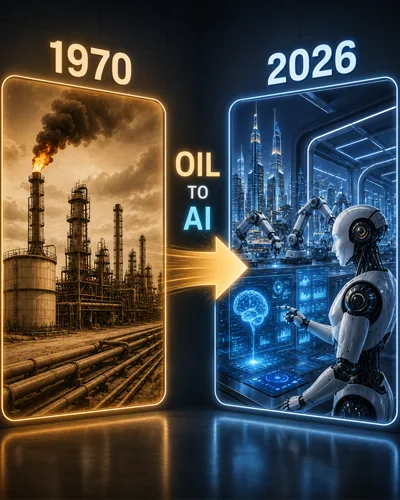
How the UAE Moved From Oil to AI in 2026: Autonomous Tech and What It Means for Dubai Property

How the UAE Moved From Oil to AI in 2026: Autonomous Tech and What It Means for Dubai Property

The UAE built its modern economy on oil, but by 2024 non-oil sectors already contributed 75.5% of GDP (Federal Competitiveness and Statistics Centre, 2024).

The next chapter is artificial intelligence: government targets put AI at 20% of non-oil GDP by 2031 (UAE Government portal). For property buyers, this matters. Economic diversification is the quiet engine behind Dubai’s housing demand.

UAE's Shift From Oil to AI: Impact on Dubai Property

The headline reads like a slogan, but the shift is measurable, funded, and already reshaping where capital and people move inside the UAE. The honest answer to whether this affects property is: yes, but not evenly. Some communities ride the AI economy directly through real jobs and infrastructure. Others carry the label without the fundamentals behind it. The difference between those two is what decides your actual return as an investor.

At Honey Money Real Estates (ORN: 28658), the most common mistake we see is buyers treating “AI hub” or “smart community” as a price justification on its own. A marketing deck citing autonomous transport or a digital-twin building does not move net yield. Verified infrastructure, real job creation, and transaction liquidity do. The narrative is real; the pricing discipline still has to be yours.

This guide draws on PwC and McKinsey economic forecasts, the UAE Government portal, the Central Bank of the UAE, the IMD Smart City Index, DLD records, Knight Frank, and reporting from Gulf News, The National and Khaleej Times through May 2026. Estimates are labelled. Read this before you sign.

1. The Oil-to-AI Pivot: What Actually Changed

The UAE did not abandon oil. It built a second economy alongside it, and AI is now the centre of that second economy.

The diversification is already structural. By 2024, non-oil sectors contributed 75.5% of UAE GDP, with trade at 16.8%, manufacturing 13.5%, financial services 13.2%, construction 11.7%, and real estate activities 7.8% (Federal Competitiveness and Statistics Centre, 2024). Oil is no longer the majority of the economy. It is one pillar among several.

From Diversification to an AI-Led Model

What changed in the 2020s is the named successor. The UAE launched its National Programme for Artificial Intelligence in 2017 and expanded it through the National Strategy for AI 2031 (UAE Government portal). The Digital Economy Strategy targets raising the digital sector’s share of GDP from roughly 10% in 2022 to 20% within a decade (Gulf News, 2025).

The Central Bank of the UAE projects GDP growth of 5.4 to 5.6% in 2026, with the expansion increasingly driven by non-oil sectors including technology, tourism, logistics and finance (CBUAE Quarterly Economic Review, 2026). The data shows the post-oil model is not a forecast. It is the current operating reality.

Why This Matters for Property

Property demand follows population and income. A diversified, AI-led economy attracts knowledge workers, expands high-income employment, and reduces the single-commodity risk that once made Gulf property cyclical. For a buyer, economic diversification is a stability signal, not a marketing line (CBUAE, 2026).

2. The Five Pillars: Key Factors Driving the Transition

The UAE’s AI transition rests on five concrete pillars. Each is funded and each has a property-market consequence.

The Five Pillars of the UAE AI Economy

Pillar

What It Involves

Property Relevance

National AI Strategy 2031

Federal policy targeting AI across transport, health, energy, government

Long-term demand anchor; policy certainty

Sovereign AI infrastructure

Data centres, semiconductor access, compute capacity

New industrial and commercial zones; jobs

Autonomous transport

RTA target of 25% autonomous mobility by 2030

Reshapes commute patterns and community value

AI talent pipeline

MBZUAI, One Million AI Talents, One Million Prompters

High-income knowledge-worker housing demand

Smart city systems

Digital twins, AI governance, 20-minute city planning

Building efficiency; service-charge implications

Source: UAE Government portal, RTA strategy 2026, Gulf News and Khaleej Times reporting 2025-2026. Verify programme timelines via official UAE channels before relying on delivery dates.

Sovereign Infrastructure Is the Visible Edge

The clearest 2026 signal is hardware. The UAE received its first shipment of advanced Nvidia chips for sovereign AI infrastructure, with the ambassador to the US stating the country is committing fully to American technology rather than hedging (The National, May 2026). Microsoft’s USD 1.5 billion investment in Abu Dhabi-based G42 in April 2024 anchored the compute partnership (Gulf News, 2025).

Autonomous Transport Reshapes the Map

The RTA targets 25% of all transport as autonomous by 2030 (Ministry of Economy and Tourism, UAE). Commercial flying-taxi services through a Joby Aviation and RTA partnership began rollout in early 2026, following a successful crewed eVTOL test flight in November 2025 (reporting, 2026). Do not accept verbal confirmation that any specific autonomous corridor will lift a particular community’s value. Timeline slippage is historically common.

3. Common Mistakes: What Property Investors Get Wrong

The AI narrative is real. The way buyers price it is often wrong. Here are the recurring errors.

Mistake 1: Paying a Premium for the “AI Hub” Label

A community near a tech zone is not automatically a better investment. Verify the actual employment base, transaction liquidity, and rental demand. The data shows fundamentals, not narrative, drive net yield (DLD records, 2026). A marketing deck is not a valuation.

Mistake 2: Treating Announced Projects as Delivered

Sovereign data centres, autonomous corridors, and smart-city upgrades are announced years before they operate. DEWA’s Warsan Green Data Centre, for example, is under construction, not live (Digital Dubai, 2026). Buy on what is built, not on what is promised.

Mistake 3: Assuming the Connectivity Uplift Is Guaranteed

Some sources project Dubai property values rising due to mobility and connectivity improvements (industry estimate; verify before relying on this figure). Treat all such forecasts as scenarios, not commitments. Infrastructure-driven appreciation is real but slow and uneven.

Mistake 4: Overpaying for “Smart Building” Branding

A digital-twin or AI-managed building can reduce operating costs, but only if that efficiency reaches the service charge. Verify the actual Mollak service charge rate before purchase (Mollak Verified, 2026). Branding that does not lower your net cost is not worth a premium.

Mistake 5: Ignoring Where the Jobs Actually Land

AI employment concentrates in specific zones: DIFC’s AI campus, Dubai Internet City, Dubai Silicon Oasis, Abu Dhabi’s Masdar City and the Mohamed bin Zayed University area. Demand follows employment geography. This is non-negotiable due diligence: match the property to where the workers actually are.

4. The Real Numbers: AI’s Economic Contribution and Property Signals

The economic case for the AI transition is large and quantified. Here are the verified figures.

AI’s Projected Economic Contribution

Metric

Figure

Source

AI contribution to UAE GDP by 2030

Approximately 14%, around USD 96 billion

PwC, cited 2026

AI target share of non-oil GDP by 2031

20%

UAE Government portal

UAE AI market size 2023

AED 12.74 billion

Trends Research & Advisory

UAE AI market projection 2030

AED 170.14 billion (44% CAGR)

Trends Research & Advisory

UAE GDP growth forecast 2026

5.4 to 5.6%

CBUAE Quarterly Review, 2026

Non-oil share of UAE GDP 2024

75.5%

Federal Competitiveness and Statistics Centre

UAE AI adoption (working-age population) end-2025

64%

Microsoft AI diffusion report, 2025

Source: PwC and Trends Research & Advisory forecasts cited through 2026, Central Bank of the UAE Quarterly Economic Review 2026, Federal Competitiveness and Statistics Centre 2024 data, Microsoft AI diffusion report 2025. Forecasts are scenario-based; verify before relying on them for investment decisions.

What the Numbers Signal for Housing

AI is projected to add close to USD 96 billion to UAE GDP by 2030 (PwC, 2026). Economic output of that scale supports sustained population growth and high-income employment. Real estate activities already contribute 7.8% of GDP directly (Federal Competitiveness and Statistics Centre, 2024).

Dubai’s D33 economic agenda targets doubling the emirate’s economy by 2033, with a digital economy contributing AED 100 billion annually to Dubai GDP (Digital Dubai, 2026). The data shows housing demand has a structural, policy-backed tailwind through the next decade.

5. Who This Applies To: Investor Profile Matching

The AI economy does not change the answer for every buyer. It changes it for some. Match your profile honestly.

Profile Matching: The AI-Economy Thesis

Profile

Recommendation

Reason

Long-term hold investor (7-10 years)

Position now

Diversification reduces single-commodity risk over the hold

Knowledge-worker end-user

Buy near actual AI employment zones

Live where the jobs and amenities concentrate

Yield-focused investor

Ignore the AI label; chase verified yield

Narrative does not move net return

Short-term flipper (under 2 years)

The thesis does not help you

Infrastructure-driven uplift is slow

HNW capital-preservation buyer

Diversified economy supports the case

Macro stability matters more than AI specifically

First-time buyer on a budget

Buy fundamentals, not futurism

Affordable communities with real demand still win

Source: Profile mapping based on CBUAE 2026 macro outlook, DLD transaction data 2026, Knight Frank Dubai residential commentary 2026. Match the product to the goal before committing capital.

The Honest Read

The AI economy strengthens the long-term Dubai property case by reducing the risk that an oil-price shock derails the market. It does not turn a weak community into a strong one. Buy because the fundamentals are sound and the macro backdrop is improving, not because a project carries an AI label.

6. Oil Economy vs AI Economy: A Property Investor’s Comparison

The shift from an oil-anchored to an AI-anchored economy changes the risk profile of UAE property. The comparison below frames what that means.

Oil-Era vs AI-Era Property Investment Context

Factor

Oil-Anchored Era

AI-Anchored Era (2026 Onward)

Primary GDP driver

Hydrocarbons

Non-oil sectors at 75.5% of GDP

Demand cyclicality

Tied to oil-price cycles

Broader, less single-commodity dependent

Job creation pattern

Energy, construction, trade

AI, tech, finance, logistics, knowledge work

Population growth driver

Project-led, oil-revenue funded

Diversified employment and talent programmes

Government revenue base

Oil-revenue heavy

Diversifying toward non-oil and digital

Infrastructure focus

Roads, ports, energy

Smart systems, autonomous transport, data centres

Property risk profile

Higher commodity-linked volatility

Structurally steadier, policy-supported

Source: Federal Competitiveness and Statistics Centre 2024, CBUAE Quarterly Review 2026, UAE Government portal. This is a structural comparison; short-term market cycles still apply regardless of the long-term shift.

The takeaway is not that AI guarantees price growth. It is that the demand base under Dubai property is broader and less fragile than it was in the oil-dependent decades. That is a risk-reduction story, and risk reduction is worth pricing in.

7. Action Checklist: Positioning a Dubai Portfolio for the AI Decade

If the AI economy informs your strategy, translate it into discipline, not enthusiasm. Run this checklist.

Before You Buy

Verify the community’s actual employment base and transaction liquidity through DLD records rather than developer marketing. Confirm the Mollak service charge for any building marketed as “smart” or AI-managed (Mollak Verified, 2026). Distinguish announced infrastructure from operational infrastructure; buy on what is built.

Match Property to Strategy

For a long-term hold, the diversified economy supports the case across most sound communities. For knowledge-worker end-use, prioritise zones near DIFC, Dubai Internet City, Dubai Silicon Oasis, or Expo City where AI employment concentrates. For yield, ignore the AI label entirely and underwrite the net return.

Verify the Fundamentals

Run the standard due diligence regardless of the AI narrative: DLD permit verification, RERA escrow confirmation under Law No. 8 of 2007, freehold-status checks, and the full cost stack of DLD 4%, registration, and broker commission with VAT. This is non-negotiable due diligence. The AI economy does not exempt any purchase from it.

Thinking About Investing in Dubai Property?

Frequently Asked Questions

How is the UAE moving from an oil economy to an AI economy?

The UAE oil to AI economy shift is a structural transition, not a slogan. By 2024, non-oil sectors already contributed 75.5% of UAE GDP, with oil reduced to one pillar among several (Federal Competitiveness and Statistics Centre, 2024). The named successor is artificial intelligence: the National Strategy for AI 2031 targets AI at 20% of non-oil GDP by 2031, and the Digital Economy Strategy aims to double the digital sector’s GDP share to 20% within a decade (UAE Government portal; Gulf News, 2025). The transition is backed by sovereign AI infrastructure, autonomous transport targets, and talent programmes. For property buyers, the practical effect is a more diversified, less commodity-dependent demand base. Verify community-level fundamentals through DLD records before treating the macro trend as a buy signal for any specific property.

Does the UAE’s AI economy actually affect Dubai property prices?

The UAE AI economy affects Dubai property indirectly, through demand rather than direct price mechanics. A diversified, AI-led economy attracts knowledge workers and expands high-income employment, which supports housing demand over the long term (CBUAE Quarterly Review, 2026). AI is projected to add close to USD 96 billion to UAE GDP by 2030 (PwC, 2026), and Dubai’s D33 agenda targets a digital economy worth AED 100 billion annually by 2033 (Digital Dubai, 2026). However, the effect is uneven. Communities near genuine AI employment zones benefit more than those carrying the label without the fundamentals. The AI economy is a stability and demand signal, not a guarantee of price growth. Underwrite each purchase on verified fundamentals, not on the macro narrative alone.

Which Dubai areas benefit most from the AI and autonomous-tech economy?

AI employment in Dubai concentrates in specific zones rather than spreading evenly. The strongest clusters are the DIFC AI campus, Dubai Internet City, Dubai Silicon Oasis, and Expo City Dubai, with Abu Dhabi’s Masdar City and the Mohamed bin Zayed University area anchoring the capital (industry mapping, 2026). Autonomous transport, with the RTA targeting 25% autonomous mobility by 2030, may over time reshape which communities are well-connected (Ministry of Economy and Tourism, UAE). However, autonomous-corridor timelines slip frequently, so treat connectivity-driven appreciation as a slow, uneven process. Do not pay a premium today for infrastructure that is announced but not operational. Verify the actual employment base and transaction liquidity of any target community through DLD records before buying on the AI-economy thesis.

Is now a good time to invest in Dubai property based on the AI transition?

Whether now is a good time depends on your hold horizon, not on the AI narrative alone. For a long-term investor holding 7 to 10 years, the AI-led diversification of the UAE economy strengthens the case by reducing the risk that an oil-price shock derails the market (CBUAE, 2026). The Central Bank projects 5.4 to 5.6% GDP growth in 2026, increasingly driven by non-oil sectors. For a short-term flipper, the AI transition offers little, because infrastructure-driven appreciation is slow and uneven. The AI economy improves the macro backdrop; it does not turn a weak community into a strong one. Match the property to your goal, verify the fundamentals through DLD records and Mollak, and buy because the economics are sound, not because a project carries an AI label.

What mistakes should property buyers avoid when investing in the AI economy?

The most common mistake in the UAE AI economy context is paying a premium for an “AI hub” or “smart community” label without checking fundamentals. A marketing deck citing autonomous transport or a digital-twin building does not move net yield; verified employment, transaction liquidity, and rental demand do (DLD records, 2026). A second error is treating announced infrastructure as delivered, when sovereign data centres and autonomous corridors operate years after announcement. A third is overpaying for smart-building branding that never reaches the service charge; verify the Mollak rate before purchase (Mollak Verified, 2026). Finally, buyers ignore where AI jobs actually concentrate, spreading demand assumptions across communities that will not benefit equally. Run standard due diligence on every purchase, including DLD permit checks and RERA escrow verification, regardless of how compelling the AI narrative sounds.
Kapil Makhijani
Kapil Makhijani
Senior Property Advisor

Kapil Makhijani is a Senior Property Advisor at Honey Money Real Estates (ORN: 28658), with over 6 years specialising in Dubai residential investment and NRI portfolio strategy. His background in... Read More

Share Our Post