The Oasis as an investment thesis rests on four factors: land scarcity, progressive phase pricing, the Al Maktoum airport corridor, and the end-user demand shift toward large-plot villas in Dubai’s luxury segment. Each of these is a real structural driver. None of them is guaranteed. This section separates confirmed from estimated.
Factor 1: Deliberate Scarcity at Scale
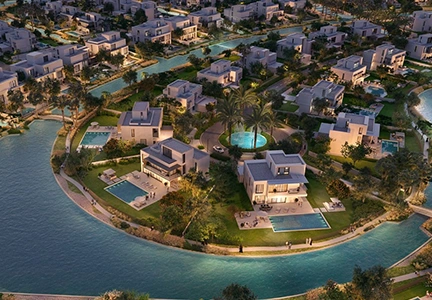
7,000 villas across 100 million sq ft means a gross density of roughly one unit per 14,000 sq ft of total community area. Dubai Hills Estate is a mixed-use community with far higher unit density. The Oasis deliberately constrains supply by dedicating 25% of land to non-residential open space and sizing every villa plot generously. This is structural scarcity, not marketing scarcity. It limits how many directly comparable products can enter the same corridor.
Factor 2: Progressive Phase Pricing
Every successive phase at The Oasis has launched at a higher price than the previous one. Palmiera Phase 1 opened at AED 8.5 million. Phases 2 and 3 launched at AED 9.18 million. Mirage opened at AED 15.8 million. Palmiera Collective launched in January 2026 at AED 16.5 million for 38 units only. This progressive pricing is Emaar’s standard strategy, observable in DLD transaction records for Dubai Hills Estate and Dubai Creek Harbour. Early-phase buyers in those communities captured documented appreciation before handover. The same mechanism is in play here, though past performance does not guarantee future results.
Factor 3: Al Maktoum Airport Proximity
The Oasis sits 18 minutes from Al Maktoum International Airport, which is undergoing a USD 35 billion expansion approved in April 2024. Phase 1 targets 150 million passengers annually with construction started Q2 2026 and first operations targeted for 2032. The relocation of Emirates airline operations from Dubai International to Al Maktoum is confirmed by Dubai Airports CEO. Properties in the airport’s residential catchment area have historically appreciated when aviation infrastructure scaled. The Oasis is positioned in that catchment.
Factor 4: The Villa Segment Is Outperforming
The DLD recorded 226,000 real estate transactions in 2024 with a combined value of AED 761 billion, a 36% increase in volume and 20% increase in value year-on-year. Dubai attracted 110,000 new investors to its real estate sector in 2024 alone, a 55% increase over 2023. In the first half of 2025, real estate transactions reached AED 431 billion, a 25% increase in value year-on-year. The villa segment reached new price highs. The Oasis is positioned in exactly this segment.
The Risks: What Could Not Work
|
Risk
|
Description
|
How to Mitigate
|
|
Timeline slippage
|
Off-plan timelines are indicative. Palmiera construction is at 65% as of early 2026. Later phases could slip.
|
Verify RERA escrow milestones before each payment. Do not rely solely on developer communication.
|
|
No rental income during construction
|
Villas cannot be rented until handover. This is a capital preservation play, not a yield play during the payment period.
|
Plan cash flow without assuming rental income until keys are received.
|
|
Limited resale comparables
|
The luxury villa segment in Dubailand is still thin for resale. Exit liquidity may be slower than apartments.
|
Hold period of at least 5 years gives time for the community to build a secondary market.
|
|
Location is not yet mature
|
The Oasis is in a developing corridor. No metro access. Some surrounding land is undeveloped. Commute to central Dubai is 30 to 35 minutes.
|
Honest lifestyle assessment before purchase. This is not a downtown address.
|
|
Service charge not yet confirmed
|
Mollak service charge rates for most sub-communities are pre-handover and not yet published.
|
Request the developer’s projected service charge rate before signing. Do not accept verbal confirmation.
|
Estimates are labelled where direct verification was not possible at time of publication.