Dubai Real Estate Market Forecast 2026 – Get Complete Outlook. The emirate is entering a mature phase following a record-breaking 2025 where transaction values reached an unprecedented AED 917 billion. This transition represents a strategic evolution from the rapid post-pandemic surge toward a period of sustainable, long term growth and structural depth.
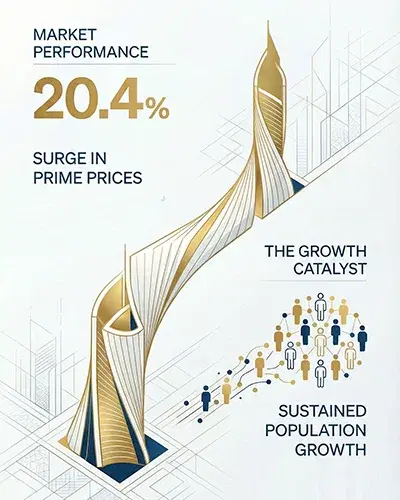
Addressing the Dubai real estate boom or slowdown 2026 debate, market data indicates that the sector is undergoing a necessary normalization rather than a crash. Annual price growth is expected to cool to a healthy and sustainable range of 3% to 8% while the overall market continues to benefit from a projected growth rate of 4.5%. This evolution highlights Dubai Resilience as the market has not only recovered from the sharp 11.7% contraction in 2020 but has also re established itself as a leading global investment destination.
Looking ahead to 2026, Dubai real estate pipeline is forecast to deliver nearly 120,000 new units. However experienced market analysts note a historical handover attrition rate of 30% to 40%, meaning actual completions are likely to be lower keeping supply more closely in balance with the city rapidly growing population. With Dubai resident base projected to reach 5.8 million by 2040, the demand for high to quality residential assets remains structurally supported by long to term migration and residency incentives.
Market Normalization vs. Crash
The current cycle is defined by a sophisticated buyer led recalibration. Unlike the double digit price surges observed between 2021 and 2024 the Dubai property price normalization in 2026 is characterized by price growth moderating to between 3% and 8%. This stabilization is a sign of health total transaction values exceeded AED 917 billion in 2025 demonstrating immense liquidity and a shift from speculative flipping to equity rich end users and long term institutional investors. This resilience is especially remarkable when contrasted with the 2020 pandemic contraction of 11.7% proving the market enduring strength.
The Blue Line Metro Property Impact
The 30 km Blue Line Metro, featuring 14 new stations, is a primary catalyst for capital appreciation. While full operations are scheduled for 9 September 2029, the Blue Line Metro property impact is already evident rents in Al Warqa and Academic City have jumped by 21% to 43% since the project was announced in 2025. Properties within walking distance of these stations command a metro premium often yielding 10% to15% faster rental cycles and up to 25% appreciation. High growth areas like Dubai Creek Harbour and Dubai Silicon Oasis are positioned to benefit most as the project reaches its 30% construction milestone by the end of 2026.
2026 Dubai Residential Supply and Demand Dynamics
While the headline pipeline for Dubai residential supply 2026 suggests 120,000 new units the Completion Threshold Framework provides a more nuanced reality. Based on construction progress, only about 48% of these units are realistically projected to reach handover in 2026. This supply is being absorbed by a population that surpassed 4 million in 2025 and is fueled by the Dubai Golden Visa real estate threshold of AED 2 million. This balance ensures that the 2040 Urban Master Plan’s target of 5.8 million residents is met with a steady, rather than oversupplied, inventory.
Top Investment Neighborhoods
- Jumeirah Village Circle (JVC): This district remains the city’s volume leader with 16,852 units expected through 2027. It offers strong rental absorption for investors seeking mid-market entry points.
- Dubai Creek Harbour: Home to the Emaar Properties Station—the world’s tallest metro station at 74 meters—this area is poised for 15%–25% appreciation as it matures into a premier waterfront luxury destination.
- Al Yalayis 1: This emerging luxury hub is attracting significant capital through specific high-profile projects. Investors should focus on Damac Islands Phase 1 and Sun City, which represent the next generation of upscale villa communities.
Investment Logic: Yields and Off-Plan Property Dubai Trends
In 2026, off-plan property Dubai trends show a decisive shift away from 1% monthly installments toward more stable 60/40 or 70/30 payment structures. This move filters for well capitalized buyers and reduces systemic risk. Regarding Dubai rental yields 2026, apartments lead with a 7.1% average gross return. While villas offer lower gross yields (5.5% to 6.0%) they remain the preferred asset class for HNWIs due to their superior capital appreciation and higher tenant stability.
Practical Buyer Guidance
Today's market rewards Quality over Hype. Investors must verify that funds are deposited into RERA mandated escrow accounts, which release capital only upon certified construction milestones. For residents the First Time Home Buyer Program remains an essential tool offering a pathway to ownership as rising rents make mortgage installments increasingly comparable to annual lease costs. Always prioritize developers with a proven track record of timely delivery and community management excellence.