Dubai Real Estate Forecast 2026: 120,000 New Units Supply Wave

Dubai Real Estate Forecast 2026: 120,000 New Units Supply Wave

When you hear the figure 120,000 units scheduled for 2026, it’s natural for an investor’s pulse to quicken. In most global markets, a sudden 5%–10% increase in total housing stock would

signal a crash. But Dubai is not a "most global markets" case study.
To make an informed decision for 2026, you need to look past the scary headlines and understand the mechanical reality of how this city builds and breathes. 

So here let us deep dive into why 2026 is actually a year of Strategic Entry, not a year of retreat.

The "Handover Gap": Why 120,000 is a Ghost Number

The first thing every seasoned Dubai investor knows is that "Scheduled" does not mean "Delivered." Dubai’s construction history shows a consistent "slippage" rate. 

So between 2022 and 2024, only about 56% of units promised by developers actually handed over their keys on time. Material shortages, labor logistics, and strategic phasing by master developers like Emaar Dubai and Nakheel act as a natural "release valve" for the market.

The list to Checkout:

  • Scheduled for 2026: 120,000 units (roughly 100k apartments and 20k villas/townhouses).
  • Realistic Delivery: Based on a 55% completion rate, we are likely looking at 66,000 actual handovers.
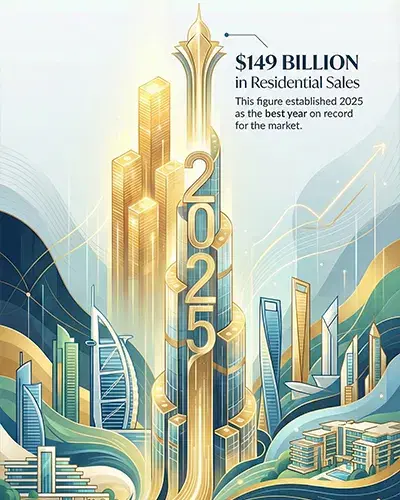
  • The Absorption Needs: Dubai added 231,000 residents in 2025 alone. At an average household size of 3.5, the city needs ~66,000 units annually just to keep up with new arrivals.

Investor Verdict: The supply wave is not an "excess"; it is a catch-up for the massive population surge of the last three years.

The Population Engine: 4 Million and Beyond

In August 2025, Dubai hit a historic milestone: 4 million residents. The government’s 2040 Master Plan aims for 5.8 million. Unlike the speculative bubbles of 2008, the 2026 market is driven by End-Users.

  • The Golden Visa Effect: Over 250,000 long-term residencies have been issued. People aren't just here for a two-year contract; they are enrolling kids in schools and buying furniture.
  • The Shift to Ownership: With rents rising 6%–10% annually, the "Mortgage vs. Rent" math now favors the buyer. In 2025, mortgage transactions surpassed cash deals for the first time in years.

The 2026 Yield Map: Identifying the High-Performers

As an investor, your "Gross Yield" is your shield. While capital appreciation may moderate to 5–8% (compared to the double-digit craziness of 2023), the rental income in Dubai remains among the highest globally.

Projected 2026 Yield Performance by Community

Community Property Type with their estimated Rental Yield, Risk Level Why?

Community

Property Type

Est. Yield (Gross)

Risk Level

Why?

Dubai Investment Park (DIP)

Apartment

10.2%

Low

High demand from metro-commuters; low entry price.

Jumeirah Village Circle (JVC)

Apartment

8.1%

Medium

High supply, but extreme popularity with mid-income expats.

Dubai South (Expo City)

Apartment

7.5%

High

Speculative growth due to the Al Maktoum Airport expansion.


Community Property Type Est. Yield (Gross) Risk Level Why?
Business Bay Apartment .4% Low The "New Downtown"; permanent demand from office workers.
Dubai Hills Estate Villa 5.8% Very Low Massive capital protection; families rarely move once settled.
Palm Jumeirah Ultra-Luxury 4.5% Very Low Trophy asset; supply is physically capped by the sea.

The "Villa Scarcity" Factor

If you want the safest possible investment in 2026, look at the dirt, not the sky.

Of the 120,000 units in the pipeline, nearly 85% are apartments. The supply of villas and townhouses remains critically low.

High-net-worth individuals (HNWIs) are moving to Dubai in record numbers (over 9,800 millionaires relocated in 2025 alone). These families don't want 1-bedroom apartments in JVC; they want 5-bedroom villas in Dubai Hills, Tilal Al Ghaf, Arabian Ranches. Or The Heights Country Club & Wellness. As you can't "manufacture" more land in prime areas easily, the villa segment will likely see 10–12% appreciation even if the apartment market stays flat.

Managing the Risks: What Could Go Wrong?

I wouldn't be giving you an honest review if I didn't mention the "Pinch Points."

A. Secondary Market Saturation:

In 2026, if you own a "generic" apartment in a building with no unique features, you will face competition. When 10 neighboring buildings hand over at once, tenants will move for a "one month free" offer.

  • The Fix: Buy units with a "Pricing Moat" park views, corner layouts, or proximity (under 800m) to a Metro station.

B. The Interest Rate Lag:

While global rates are stabilizing, borrowing costs are still higher than in the "cheap money" era of 2020.

  • The Fix: If you are financing, ensure your rental income covers at least 1.5x your mortgage payment to account for maintenance and vacancy.

C. The "Fake" Luxury Trap:

Many "Luxury" projects launching now are just standard builds with gold-colored faucets.

  • The Fix: Stick to Tier-1 developers (Emaar, Sobha, Ellington, Select Group). Their buildings age better, have higher resale velocity, and maintain their "premium" status 10 years down the line.

Critical Analysis: Should You Buy Now or Wait?

Many investors ask: "Should I wait for the 15% correction that Fitch predicted?"

Here is the "Human" reality: Even if a 10% correction happens in certain oversupplied pockets (like mid-tier apartments in JVC), you will likely have paid out 10% of the property value in rent while waiting.

Furthermore, "Waiting for a dip" in Dubai often means missing out on the best units. In a 120,000-unit year, the top 10% of properties (best views, best developers) will not drop in price they will only become harder to find.

The 2026 Investor Playbook

  • For Cash-Flow Hunters: Look at DIP, Silicon Oasis, or Arjan. Aim for studios and 1-beds. The "yield" is your primary goal.
  • For Wealth Preservation: Buy Villas or Townhouses in gated communities. These are the "Blue Chip" stocks of Dubai real estate.
  • For Growth Speculators: Look at Dubai South. With the recent multi-billion dollar investment into the Al Maktoum International Airport, this area is the "Long Game" (5–10 years).

Final Verdict

Dubai in 2026 is moving from a "Speculative Sprint" to a "Structural Marathon." The 120,000 units are a sign of a city that is finally building enough to house its own success. For an investor, this means less "overnight doubling" of money, but a much more stable, predictable, and high-yielding asset.

Share Our Post