Oqood vs Title Deed in Dubai: 2026 Guide for Off Plan Buyers

Oqood vs Title Deed in Dubai: 2026 Guide for Off Plan Buyers

  • Written byKapil Makhijani,Senior Property Advisor
  • Buyer's Guide
  • Reviewed by Vikas Taneja, RERA Certified Broker, BRN 82127
  • Published: 05 Nov 2026
  • 12 min read
Add us as aPreferred Source

Off plan deals made up 72% of Dubai home purchases in Q3 2026, so most new buyers hold an Oqood rather than a title deed. Switching that registration to a title deed at handover costs AED 520 in fixed government charges for an apartment or villa, and the developer, not the buyer, files it. Miss instalments before completion and the developer may keep a set share of the unit value.

Oqood and title deed are 2 stages of the same purchase in Dubai. Which one you hold depends on whether the building is finished and the title deed has been issued to you. An Oqood records your purchase of an unfinished unit. A title deed confirms you own a completed property. The rights, costs, and resale options attached to each are different, and treating the 2 documents as equal can lead to costs a buyer did not plan for.

A buyer on a post handover payment plan should not assume the keys and the title deed arrive on the same day. The registry issues the deed only after the developer files for it and the buyer is compliant with the contract. Until then, the buyer can be living in the home with only the Oqood on file, so the timing needs to be written into the SPA.

This guide uses the current Dubai Land Department online service tariffs, the text of the interim register law and its 2020 amendment, the 2026 tokenisation announcements, and residential sales totals for the third quarter of 2026. Every fee quoted is a published Dubai Land Department charge, not a broker estimate.

Oqood Meaning in Dubai: Off Plan Registration and the Title Deed Explained

An Oqood is the registration certificate the Dubai Land Department issues when a developer records the sale of an unfinished unit, while a title deed is the certificate of ownership issued once the property is complete and recorded in the owner's name. The Arabic word Oqood means contracts, and the register records each off plan sale against a named buyer.

Oqood Certificate Dubai: What the Interim Register Records

The Oqood certificate is issued under Law No. 13 of 2008, which created the Interim Real Estate Register for units sold before completion. The certificate names the buyer, the developer, the project, the unit number and the agreed price.

Title Deed in Dubai: Ownership Under the Permanent Register

A title deed in Dubai is recorded in the permanent Real Estate Register set up under Law No. 7 of 2006. It names the owner and describes the plot or unit, its area and its location. The holder can sell, lease, mortgage or gift the property. The Dubai Land Department now issues the deed as an electronic certificate with a matching electronic map, sent to the owner by email.

Why Most New Buyers in Dubai Hold an Oqood Today

The data shows that most homes sold in Dubai today are off plan. Dubai recorded about 34,000 residential sales in Q3 2026, and off plan deals were 65% of that quarter's sales value. Sales volume in that quarter was 38% lower than in Q3 2025 amid regional uncertainty. Across 2025, the emirate completed more than 270,000 property transactions worth AED 917 billion.

Convert Oqood to Title Deed: The Handover Process Step by Step

Converting an Oqood to a title deed happens only after the building is complete, and the developer files the request through the Oqood portal. The buyer's part is to clear every amount due, complete the handover paperwork and confirm the developer has submitted the request. The 5 stages below show the usual order.

  1. Project completion: The developer receives completion approval for the building and sends handover notices to buyers with the final amount due.
  2. Final payment: The buyer clears the balance. The registry issues the deed only to buyers who are compliant with their contract.
  3. Inspection and handover: The buyer inspects the unit, records any snags in writing and signs the handover documents before collecting the keys.
  4. Title deed request: The developer submits the title deed request on the Oqood portal and pays the fixed charges shown in section 4.
  5. Issue of the deed: The electronic title deed and electronic map are emailed to the owner. The published service time is 6 business days.

A post handover payment plan changes this order. When part of the price is still owed after keys are released, the SPA terms decide when the title deed is issued, not the handover date. Ask the developer to state in the SPA when the title deed will be issued under your plan. Do not accept verbal confirmation.

Off Plan Registration Mistakes: Where Oqood Holders Lose Money

Most money lost on an Oqood comes from 3 sources: missed instalments, contracts that were never registered and resale plans the SPA does not allow. Each can be avoided if the buyer reads the contract against the law before paying the booking amount.

Missed Instalments: What a Developer Can Legally Keep

When an Oqood holder misses payments, the developer must first report the default to the Dubai Land Department, which gives the buyer 30 days to pay or settle. If the buyer does not pay or settle within that period, the unit's completion level decides the developer's options under Article 11 of the interim register law, as replaced by Law No. 19 of 2020.

  • Above 80% complete: keep the contract and claim the balance, request a public auction of the unit, or cancel and keep up to 40% of the unit value.
  • 60% to 80% complete: cancel and keep up to 40% of the unit value.
  • Below 60% complete, with construction started: cancel and keep up to 25% of the unit value.
  • Work not started for reasons outside the developer's control, without its negligence: the developer must refund all payments.

When the developer cancels in the first 3 cases, any amount paid above the deduction must be refunded within 1 year of cancellation or within 60 days of resale to a new buyer, whichever comes first. The same full refund applies if RERA cancels the project, under Law No. 8 of 2007 on escrow accounts.

Assuming the Contract Was Registered

A signed SPA is not an Oqood. The developer must register the sale in the interim register within 90 days of signing. Ask for the Oqood certificate after that window and check that the unit number, price and buyer names match your SPA exactly. This is non-negotiable due diligence, because an unregistered contract gives far weaker protection.

Treating an Oqood as a Free Resale Right

An Oqood holder cannot transfer the unit without the developer's approval, and the conditions for that approval are set in the SPA. Investors planning to exit before handover should find that clause before signing, not after the market moves.

Oqood Registration Fees and Title Deed Fees in Dubai: 2026 Cost Breakdown

Oqood registration fees are a percentage of the price, while the title deed issued at handover costs a small fixed amount. The table lists the published Dubai Land Department charges for each stage of an off plan purchase and for a later resale of a completed unit.

Charge

Stage

Amount

Initial sale registration, buyer share

Oqood

2% of price

Initial sale registration, developer share

Oqood

2% of price

Developer self registration on the Oqood portal

Oqood

AED 1,000

Knowledge fee and innovation fee

Every registration

AED 10 each

Mortgage registration on an off plan unit

Oqood with bank finance

0.25% of loan amount

Title deed certificate

Handover

AED 250

Apartment or villa map

Handover

AED 250

Trustee centre fee, completed unit resale

Title deed sale

AED 4,000 + VAT at AED 500,000 and above, AED 2,000 + VAT below

The tariff splits the registration fee between developer and buyer, but the SPA decides who pays each half. Read the fee clause in the SPA rather than the brochure.

For an AED 1,500,000 apartment where the buyer pays the whole registration, the Oqood stage costs AED 60,020 including the knowledge and innovation fees. The title deed at handover then adds the fixed certificate, map and fees, bringing total registration charges across both stages to AED 60,540.

Oqood Transfer and Resale: Rules for Investors, End Users and Mortgage Buyers

Oqood transfer rules differ for each type of buyer, because an investor selling early, a family changing units and a mortgage buyer each deal with a different registry service. The first 3 cases below apply while the unit is still in the interim register, and the last covers owners who already hold a title deed.

Investors Selling Before Handover

To sell off plan property with Oqood, the investor needs the developer's approval, and the sale is then registered in the new buyer's name with registration fees charged on that sale. Ask the developer for the full transfer cost in writing before listing the unit, so the expected gain is measured against the real exit cost.

End Users Who Want a Different Unit

A buyer who wants to move to another unit in the same developer's projects can use the registry's fee transfer service. With the developer's agreement, approval from the registry's legal department, a settlement agreement and a new SPA, the registration already paid moves to the new unit, and fresh fees apply only to any increase in price.

Buyers Using Bank Finance

A bank loan on an unfinished unit is registered together with the Oqood through the Oqood portal. Before accepting the loan offer, ask the bank how it handles a resale before handover and the move from Oqood to title deed.

Owners Who Already Hold a Title Deed

A title deed holder in a freehold area sells through a registration trustee centre or the Dubai Now app, and the published service time is 20 minutes. The seller needs an electronic no objection certificate from the developer, requested through the Dubai REST app.

Difference Between Oqood and Title Deed: Side by Side Comparison

The main difference between Oqood and title deed is that an Oqood proves a registered purchase of an unfinished unit, while a title deed proves completed ownership with full rights to sell, lease and mortgage. The table compares the 2 documents on 7 practical points.

Point

Oqood

Title Deed

Project stage

Under construction or not yet started

Completed and handed over

Register and law

Interim Real Estate Register, Law No. 13 of 2008

Real Estate Register, Law No. 7 of 2006

What it proves

A registered purchase contract

Legal ownership of the property

Who files it

The developer, through the Oqood portal

The developer at handover, seller and buyer on a resale

Resale

Only with developer consent

Through a trustee centre or Dubai Now, with a developer e-NOC

Renting out

Not possible until the unit is handed over

Allowed, with the lease registered in Ejari

Risk if the buyer defaults

Developer deductions under Article 11

No developer deductions; a lender can act if mortgaged

Tokenised Title Deeds: What Changed in 2026

Dubai's tokenisation pilot converts title deeds into blockchain tokens that allow fractional ownership. Phase II opened resale of about 7.8 million real estate tokens on a regulated secondary market from 20 February 2026. The Dubai Land Department expects tokenised property to reach AED 60 billion by 2033, around 7% of the emirate's transactions.

Title Deed Check Dubai: 3 Checkpoints From Booking to Handover

Title Deed in Dubai starts long before handover, because the SPA sets most of the terms that decide when and how the deed is issued. The 3 checkpoints below cover the points where a buyer can still ask for changes.

Before signing the SPA: confirm that the developer and project are registered with RERA and that payments go into the project escrow account. Then check who pays each half of the registration fee, the conditions for resale and the date the title deed will be issued under your payment plan.

After the 90 day registration window: request the Oqood certificate and match every detail with the SPA. Keep the payment receipts for each instalment in one file, because they are your proof of payment if a dispute or default notice ever comes up.

At handover: clear the final balance, inspect and record snags in writing, then follow up until the electronic title deed arrives by email. Check the owner names, unit and area on the deed, and keep the electronic map with it. A resale buyer should ask to see this deed before paying any deposit.

How This Guide Was Checked

The fees in this guide come from the Dubai Land Department's published online service tariffs as listed in October 2026. Legal thresholds come from Law No. 13 of 2008, Law No. 19 of 2020, Law No. 7 of 2006 and Law No. 8 of 2007. Market totals cover the full year 2025 and the third quarter of 2026.

Government tariffs and developer SPA terms can change. Before any payment, check the current charge on the Dubai Land Department website and read the fee, resale and title deed clauses in your own SPA.

No estimates are used in this guide. Every figure is a published tariff, a legal threshold, a reported market total or a calculation shown in full in the text.

Thinking About Investing in Dubai Property?

Frequently Asked Questions

Is an Oqood the Same as a Title Deed?

No. An Oqood certificate proves your off plan purchase is registered with the Dubai Land Department, while a title deed proves ownership of a completed property. Keep your Oqood safe until the deed is issued at handover.

How Long Does It Take to Convert Oqood to Title Deed?

Once the developer files the request after completion and your balance is cleared, the registry processes it within a few business days and emails the electronic deed. Chase the developer if nothing arrives after handover.

Can I Sell My Off Plan Property With Only an Oqood?

Yes, if the developer consents and you meet the resale conditions in your SPA. The new buyer registers the sale again in their own name, so ask the developer for the full transfer cost before listing.

Who Pays the Oqood Registration Fee in Dubai?

The official tariff splits it equally between developer and buyer, but your SPA decides who finally pays each half. Read the fee clause and confirm the amount in writing before paying the booking amount.

What Happens to My Oqood if I Stop Paying?

The developer reports the default, you get a notice period to pay or settle, and the completion level then decides how much the developer may deduct. Talk to the developer early, before the notice period ends.

Where Does My Off Plan Money Go in Dubai?

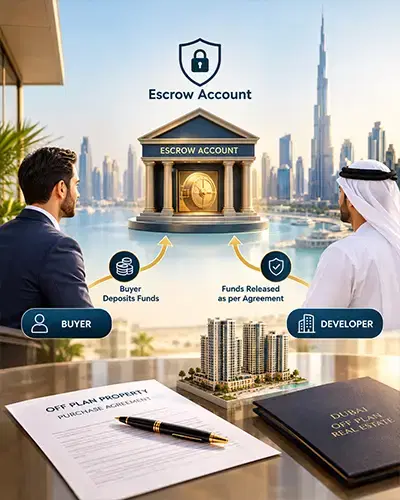
Payments for a registered off plan unit must go into the project's own escrow account, not the developer's general account. Always pay to the account named in your SPA and keep every receipt.

Can Foreigners Own Off Plan Property in Dubai?

Yes. Foreign buyers can register off plan units and receive title deeds in areas designated for freehold ownership. Confirm the project is inside a freehold zone before reserving a unit.

Can a Company Register an Off Plan Unit in Dubai?

Yes. Companies can register an off plan purchase with a valid trade licence and a legal Arabic translation of their memorandum of association. A foreign company needs free zone registration, for example in DMCC or JAFZA.

Can 2 People Share One Dubai Title Deed?

Yes. Joint buyers can register the purchase together, and each owner's name appears on the deed. Before signing, make sure every buyer's name on the SPA matches their passport exactly.

How Do I Verify a Title Deed Before Buying a Resale?

Ask the seller for the deed and check the owner name and area against their Emirates ID or passport and the listing. Register the sale only through official Dubai Land Department channels.
Kapil Makhijani
Kapil Makhijani
Senior Property Advisor

Kapil Makhijani is a Senior Property Advisor at Honey Money Real Estates (ORN: 28658), with over 6 years specialising in Dubai residential investment and NRI portfolio strategy. His background in... Read More

Share Our Post