Al Barari is the only community in Dubai where 60 percent of the land is not built on. It sits in Nad Al Sheba, Dubailand, directly off Sheikh Mohammed Bin Zayed Road (E311), and was conceived by founder Zaal Mohammed Zaal around a single principle: that nature and ultra-luxury living do not have to be traded against each other. Nearly two decades later, that principle still separates Al Barari from every other gated community in Dubai.

The 15.3 million sq ft master development is the region's first integrated eco-community. Where most Dubai communities allocate a percentage of land to parks as an afterthought, Al Barari was designed in reverse 34 themed botanical gardens, naturalised lakes, freshwater streams, and wildlife corridors were laid first, and the homes were placed within them. The result is a cooler, quieter, and demonstrably greener environment that residents consistently describe as unlike anywhere else in the city.
This guide covers the community's character, location, lifestyle infrastructure, educational and healthcare access, the investment case, and an honest assessment of who Al Barari actually suits. Property-specific information sub-community details, pricing, and availability is covered separately in the dedicated projects section.
Developer: Al Barari Development Company LLC, founded in 2005 by Zaal Mohammed Zaal. This is a family business with a single focus Al Barari is the company's only large-scale development. The founder lives in the community with his family, a fact that signals genuine conviction in the product. The company has received multiple industry recognitions including Meed Sustainable Project of the Year (2015) and Gulf Real Estate Awards Best Real Estate Project (2017).
Scale and density: The master plan covers 15.3 million sq ft approximately 1.4 sq km of Nad Al Sheba. Of that, only 40% is built upon. The remaining 60% is dedicated to botanical gardens, lakes, waterways, and green corridors. Some zones within the community have even higher green-to-built ratios. This is not a planning aspiration; it is the structural layout of the community, visible from any satellite image.
Development timeline: Development began in 2007. Phase I completed around 2012, establishing the community's core residential fabric. Phase II extended the offering with further residential sub-communities. The community continues to evolve with new residential launches. The total estimated project cost across all phases is AED 23.5 billion.
Sustainability infrastructure: Al Barari was designed in line with Dubai Municipality's Environmental Impact Assessment framework for green communities. Key systems include an underground domestic waste separation facility, a district cooling network that residents report reduces energy costs by up to 50% versus conventional AC, and a specialist irrigation setup that sustains aquatic plants, birds, and fish within the community's waterways. The plant nursery within the community the region's largest privately-owned nursery supplies greenery for the gardens and is operational as a functioning horticultural asset.
Freehold status: Al Barari is a designated freehold area in Dubai. Non-UAE nationals can own property with full freehold title. Properties valued at AED 2 million or above qualify buyers for the UAE 10-year Golden Visa.
Al Barari Location in Dubai: Nad Al Sheba District & Dubailand Connectivity
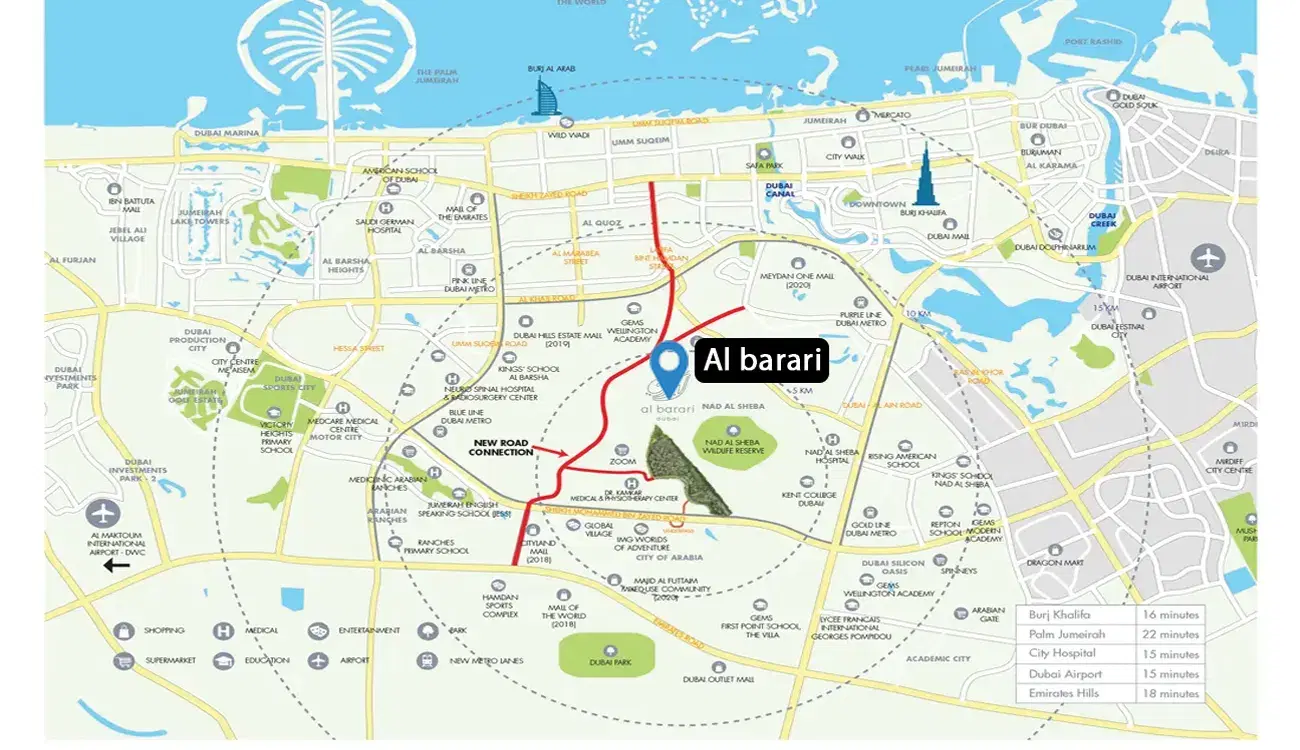
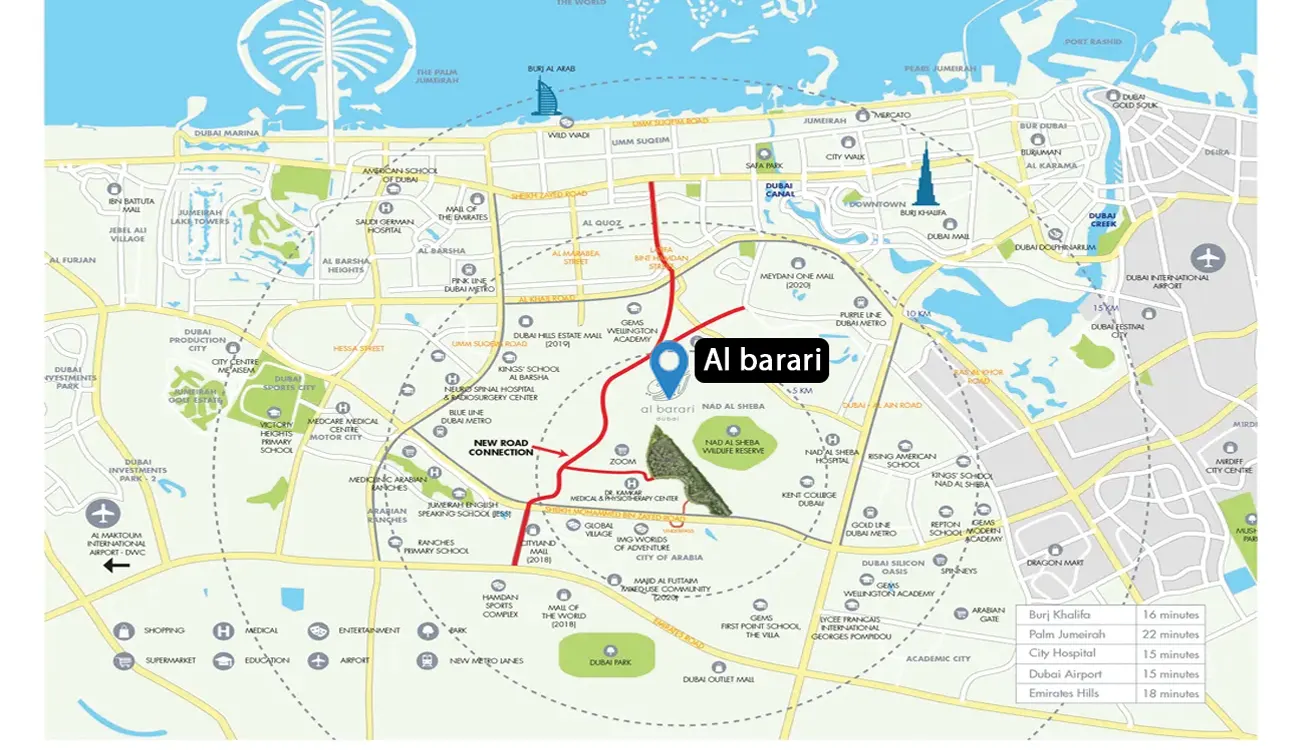
Where it sits: Nad Al Sheba district, Dubailand. The community entrance sits directly off E311 (Sheikh Mohammed Bin Zayed Road), positioned between E311 and Al Khail Road (E44). The most useful orientation landmark: the community is opposite Global Village and City of Arabia, which most Dubai residents know immediately. GEMS Heritage Indian School sits at the community entrance.
For drivers, E311 provides fast access to central Dubai, the airport corridor, and Business Bay. Al Khail Road (E44) provides the secondary western route toward Dubai Hills Estate and Dubai Marina. The geography is genuinely central for a low-density community of this character Al Barari manages the unusual combination of feeling remote from the city while being 25 km from Downtown.
Al Barari Lifestyle: Dubai’s Most Peaceful Low-Density Community
Al Barari has a pace unlike any other Dubai community at any price point. Internal roads carry almost no through traffic. The 34 botanical gardens themed across styles including Renaissance, Balinese, Mediterranean, Woodland, Lagoon, and Contemporary form a continuous green network that residents can walk or cycle through without encountering a public road. The freshwater streams, cascades, and naturalised lakes that run through the green corridors support fish, birds, and aquatic plants, creating an ecosystem rather than a landscaping feature.
The microclimate is noticeably cooler than surrounding areas, a direct consequence of the water features and vegetation density. Residents who have lived here cite this consistently. It is one of the few places in Dubai where outdoor morning exercise in summer is genuinely tolerable rather than performative.
The resident profile is predominantly international high-net-worth families: European, South Asian, and Arab buyers who have chosen Al Barari as a long-term home rather than a speculative asset. The community has a genuine neighbourhood feel relatively small total population across a large land area, shared social spaces, and a resident events programme that is active rather than token.
Al Barari Amenities: Luxury Lifestyle, Wellness & Dining in Dubai
The Farm: Al Barari's signature dining venue an al fresco gourmet restaurant set within the botanical gardens, with an organic and health-conscious menu. The Farm operates as a destination in its own right, drawing diners from across Dubai. Booking in advance on weekends is standard practice. It opened alongside the community's earliest residential phase and remains the social and culinary anchor of Al Barari life.
Heart & Soul Spa: A destination wellness centre with 11 industry awards for its treatment programmes. The offering spans hydrotherapy, integrative medicine, and bespoke wellness therapies. It is a purpose-built facility not a hotel spa annexed to a gym and occupies a dedicated building within the community grounds.
Body Language Fitness Club: A full-format health club with gym equipment, group fitness classes, and personal training. The scale and quality is comparable to premium standalone fitness clubs in Dubai, not the typical building-level gym.
The WELL Retail Centre: Anchored by a Waitrose supermarket, alongside a pharmacy, barber, nursery, and boutique shops. It serves daily needs without requiring residents to leave the community for routine essentials. Larger grocery runs typically involve Spinneys in nearby The Villa community (~22 minutes).
Beyond the signature amenities, the community's everyday infrastructure includes cycling and jogging tracks through the landscaped corridors, children's playgrounds with splash pads and a skate park, a Prime Medical Center within the community boundary (dental, family medicine, paediatrics), and the Zaya Al Barari boutique hotel within one of the residential clusters useful for visiting family and guests.
The district cooling system deserves specific mention as a practical amenity: residents report energy cost savings of up to 50% versus conventional air conditioning. In a community where properties are large and the Dubai climate is what it is, that is a meaningful ongoing saving.
Education in Al Barari Dubai: American Curriculum from KG to Grade 12
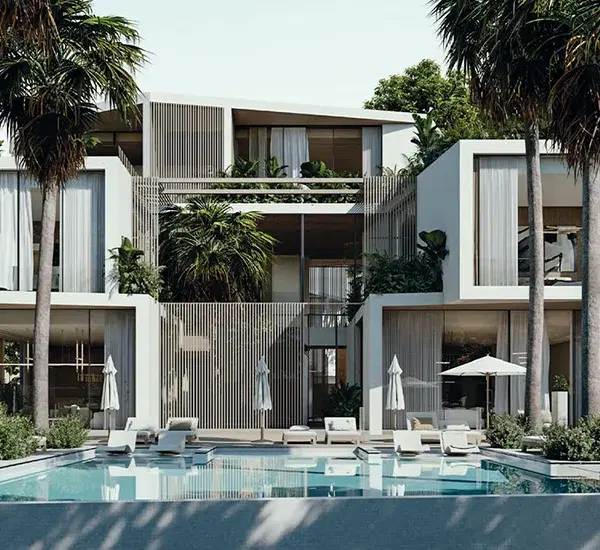
Dunecrest American School operates within the community boundary one of the few Dubai communities to have a school literally inside the gates. This is a meaningful quality-of-life feature for families with school-age children: no school run, no morning traffic, no weekday logistics around drop-off. The school offers the American curriculum from KG through Grade 12.
| School / Institution | Curriculum | Approx. Distance |
|---|---|---|
| Dunecrest American School | American / US Curriculum | With in community 2–5 minutes |
| GEMS Heritage Indian School | CBSE / Indian | At community entrance 2 minutes |
| Repton School Dubai | British | 20 minutes |
| GEMS First Point School | British / National Curriculum | 22 minutes |
| Safa Community School | British | 25 minutes |
| Nord Anglia International School | British / IB | 25 minutes |
| Dubai International Academic City | Higher Education hub | 20 minutes |
The combination of Dunecrest American School within the community and GEMS Heritage Indian School at the entrance makes Al Barari unusually self-contained for families with school-age children. Most gated communities require a 15–25 minute school run. Here, the school is part of the community's daily infrastructure.
Al Barari Lifestyle Benefits: Integrated Healthcare & Wellness Facilities
Prime Medical Center operates within the community, covering dental, family medicine, and paediatrics routine healthcare needs without leaving the gates. For specialist and emergency care, a wider set of facilities is accessible within a 20–30 minute drive.
| Facility | Type | Approx. Distance |
|---|---|---|
| Prime Medical Center (on-site) | GP, dental, paediatrics | With in community |
| Mediclinic Parkview Hospital | Full-service hospital | 18 min |
| Mediclinic City Hospital | Full-service hospital | 25 min |
| Saudi German Hospital | Multi-specialty hospital | 20 min |
| American Hospital Dubai | Full-service / specialist | 28 min |
| Aster Clinic, Silicon Oasis | Multi-specialty clinic | 20 min |
Lifestyle Around Al Barari Dubai: Shopping, Dining & Entertainment Options
The WELL retail centre anchored by Waitrose covers daily grocery and pharmacy needs within the community. For broader retail, Cityland Mall is 5–8 minutes away a family-oriented destination mall with international and regional retail brands, dining, and entertainment. Dubai Hills Mall and Mall of the Emirates are each within a 20–22 minute drive.
The Farm functions as the community's primary dining destination, but a broader set of restaurant and café options exists along the E311 corridor and within City of Arabia (3–5 minutes). Global Village, directly adjacent, adds a seasonal entertainment and dining dimension during its October–April operating season.
Al Barari Investment Guide: Freehold Property & Golden Visa Benefits
Freehold & Golden Visa: Al Barari is a confirmed freehold area. All nationalities can own property outright. Properties valued at AED 2 million or above qualify for the UAE 10-year Golden Visa a threshold that covers the full range of Al Barari's apartment and villa products.
Rental yields: Villa yields in Al Barari sit in the 5–7% gross range. Bayut's 2024 data places villa yields at approximately 6.45% above the Dubai-wide villa average of approximately 4.9% (DXB Interact / REIDIN). Luxury apartments within the community have returned yields of 7–9% in some analyses, partly driven by short-term rental and boutique-hotel demand. These are gross figures; service charges in a heavily landscaped community of this scale will be higher than typical Dubai developments, and net yield calculations should account for this.
Capital appreciation: Al Barari recorded a 111% price increase from January 2022 to recent market data. In the first nine months of 2023, the community outperformed Palm Jumeirah, Emirates Hills, and Arabian Ranches combined for investment deal volume growth a 400% year-on-year increase. Average transaction values sit around AED 30 million, reflecting the community's positioning firmly in the ultra-luxury tier.
Buyer profile: The dominant buyer is an international HNWI primarily European, with a growing South Asian segment purchasing Al Barari as a primary residence or long-term lifestyle asset rather than a speculative play. This profile produces stable, long-duration tenancies in the rental market and long hold periods for owner-occupiers, both of which reduce market volatility.
Who Is Al Barari Best Suited For?
Families with children: The primary buyer profile. Large villa footprints, private pools, private gardens, Dunecrest American School within the gates, and low internal traffic make Al Barari functionally well-suited to family life. The nature-immersed environment genuinely rare in Dubai is consistently cited as the deciding factor over alternatives like Arabian Ranches or Dubai Hills Estate.
International HNWIs seeking a lifestyle asset: Strong capital appreciation, freehold ownership, Golden Visa eligibility, and the distinctive 'only truly green community in Dubai' positioning make Al Barari attractive to buyers placing AED 10M+ who want a stable appreciating asset with international brand recognition and genuine lifestyle differentiation.
NRI and South Asian buyers: GEMS Heritage Indian School at the entrance and proximity to Dubai International Academic City make Al Barari a practical choice for Indian families relocating to Dubai. The CBSE option at the gate removes one of the primary logistical barriers for NRI families. Remote purchase works as with any Dubai freehold.
Who Al Barari is not for: Buyers who need metro access, walkable high-street retail, or a city-centre commute under 10 minutes. The deliberate seclusion is inseparable from what the community offers buyers who try to overlay an urban lifestyle onto Al Barari's location will find the geography frustrating. The community rewards those who have consciously chosen the trade-off.
Al Barari is in the Nad Al Sheba district of Dubailand, directly off Sheikh Mohammed Bin Zayed Road (E311). The community entrance is opposite Global Village and City of Arabia. It sits between E311 and Al Khail Road (E44), approximately 25 km from Downtown Dubai and 25 km from Dubai International Airport.
Al Barari Development Company LLC, a family business founded in 2005 by Zaal Mohammed Zaal. It is the company's sole focus they do not operate as a volume developer across multiple sites. The founder lives in the community with his family. The company has received multiple awards including Meed Sustainable Project of the Year (2015).
Yes. Al Barari is a designated freehold area in Dubai. Non-UAE nationals can purchase residential properties with full freehold title registered with the Dubai Land Department. Properties valued at AED 2 million or above qualify for the UAE 10-year Golden Visa.
60% of the total land area is not built upon. The built environment occupies approximately 40% of the 15.3 million sq ft master plan. The remaining 60% and higher in specific zones is given over to 34 themed botanical gardens, naturalised lakes, freshwater streams, and landscaped corridors. This is the community's defining structural feature, not a marketing approximation.
Yes. Dunecrest American School operates within the community boundary, offering the American curriculum from KG through Grade 12. GEMS Heritage Indian School (CBSE curriculum) sits at the community entrance. These two options cover the most common curriculum preferences among Al Barari's international resident population without requiring a school run outside the community.
Yes, in practice. There is no metro station within Al Barari or directly accessible from the community. The nearest stations are approximately 20 minutes away. Bus routes serve Global Village, a short taxi ride from the entrance. Most residents commute by car. The E311 and E44 access make the wider city reachable, but daily life within the community is structured around private vehicle use.
The Farm restaurant (organic gourmet dining, al fresco, within the botanical gardens), Heart & Soul Spa (award-winning wellness centre), Body Language Fitness Club (full-format gym), The WELL retail centre (Waitrose-anchored), Prime Medical Center (on-site GP, dental, and paediatrics), cycling and jogging trails through the green corridors, children's playgrounds and skate park, and the Zaya Al Barari boutique hotel. District cooling is standard across the community.
The fundamental difference is density and nature. Arabian Ranches and Dubai Hills Estate are landscaped villa communities with manicured streets and parks. Al Barari is structured around naturalised botanical gardens, waterways, and wildlife 60% of the land is green, not 20–30%. The resulting microclimate, the biodiversity, and the absence of urban traffic inside the gates produce a qualitatively different living environment, at a price premium that reflects it.
In Al Barari, 2026 rental yields average 5%–6.5% for villas and 6%–7% for apartments. Higher service charges can reduce net returns, but strong demand and limited supply support steady income and long-term value, making it more of a lifestyle and appreciation-driven investment.
Both are ultra-luxury, low-density gated communities. Emirates Hills is older, closer to Dubai Marina (15–20 min), and established as a golf-front residential address with large custom-built plots. Al Barari differentiates on eco-design: 60% green space, botanical gardens, naturalised water features, and a functioning wellness ecosystem within the gates. Al Barari has more active community amenities. Emirates Hills typically transacts at higher absolute price points for comparable plot sizes. Buyers prioritising proximity to the Marina and golf-front living tend toward Emirates Hills; those choosing nature-immersion and community-integrated wellness tend toward Al Barari.
Content Reviewed By: Vikas Taneja — RERA Certified Broker (BRN: 82127), Honey Money Real Estates L.L.C. (ORN: 28658). Advising HNI and NRI buyers on Dubai off-plan and ready property, with direct transaction experience across Downtown Dubai, Dubai Creek Harbour, MBR City, Sobha Hartland, The Valley, and Dubailand communities.
Company Authority: Honey Money Real Estates L.L.C. is a DLD-registered brokerage (ORN:28658) operating under Dubai’s Real Estate Regulatory Agency (RERA). All project data on this page is cross-checked against the developer’s official documentation and DLD records. Pricing and availability are market-indicative at the time of review and subject to change.